
 An overview of the XF 18mm
 An overview of the XF 18mm
When the Fuji X-System first came out this was one of three lenses I had with the camera. It is small, light and it turned my X-Pro into a pocket camera.
Over the years I have used it less and less but that is due to the 18-55mm and later the 16-55mm already being on the camera. Although this lens is good I have just found that I never really needed to shoot at f2 at 18mm when I now can shoot at f2.8 from either of the other two lenses, thus it never really makes it in to my camera bag. This being said, It is a great all round lens that is super slim and light.
Fujifilm’s X-System cameras and lenses are all built very well despite how lightweight they actually are. Nothing feels cheap, flimsy, breakable or prone to immediate self-destruction, and I get the sense that despite the light weight, a lot of thought and planning went into the design of this system. I have read numerous opinions about the XF 18mm, many of which claim that it feels hollow, or “too light”, but I find this lightness to be a virtue.
With the 18mm on my X-Pro 1, I feel like the camera is so much more svelte and nimble in my hands over using the (admittedly not very large) 35mm f1.4 that I also own. I appreciate the solid clicks of the aperture ring, and even though it is easy to manipulate, it does not feel loose or sloppy in any way. The supplied lens hood locks tightly into place with a clockwise twist (if the front element is facing you) and it does not come loose, ever. I do think that the rubber lens caps Fuji supplies (though a welcome gesture) are a bit weak, because they have a tendency to fall off and disappear into your camera bag if you look at them the wrong way, and the included pinch-caps for covering the lens without the hood on seem to eject just as easily. But the reality is, it’s a lens-cap, so it doesn’t affect the performance of the lens in any way, shape or form. I haven’t beaten this lens up yet (well, my camera did unfortunately take a tumble onto the concrete with the lens attached, but you’d never know it by looking at it), but if it’s built anywhere as well as the 35mm f1.4 (which got pretty beat up during my trip to Europe, those tourists can sure be pushy-folk) then I feel pretty confident that this is a lens that could be utilized in a professional capacity. (Within reason of course) – ABRAM GOGLANIAN via The Phoblographer
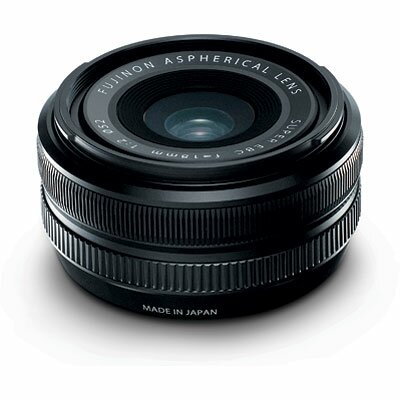
Fuji 18mm f2: Key Features
- Compact and lightweight “Pancake” type
- Using glass-mold aspheric lenses at the 5th and 7th elements, is effective to in increasing the maximum aperture (5th element) and reducing the overall thickness of the lens (7th element)
- The final element, positioned as closely to the sensor as possible, makes the incidence angle of light reaching the sensor smaller, and reduces vignetting and color shading, while helping to keep the lens’s overall size small
Pros –
Small, cheap, light, bright
Cons –
Other lenses in the range are better.
Click here to check out our image gallery



Specifications
| Type | XF18mmF2 R |
|---|---|
| Lens construction | 8 elements in 7 groups (includes 2 aspherical elements) |
| Focal length | f=18mm (135 equivalent: 27mm) |
| Angle of view | 76.5° |
| Max. aperture | F2.0 |
| Min. aperture | F16 |
| Aperture control |
|
| Focus range | Approx. 18cm – ∞ |
| Max. magnification | 0.14x |
| External dimensions | ø64.5mm x 40.6mm |
| Weight | Approx. 116g (excluding caps and hoods) |
| Filter size | ø52mm |
Lens Construction
XF18mmF2 R

Want to check out some other lens reviews ?

Click here to check out our Fuji related blogs – Interviews – Blog menu
Here are a few links to help you find some of the stuff mentioned in this blog post, also remember to sign up for the newsletter which can be found here.
